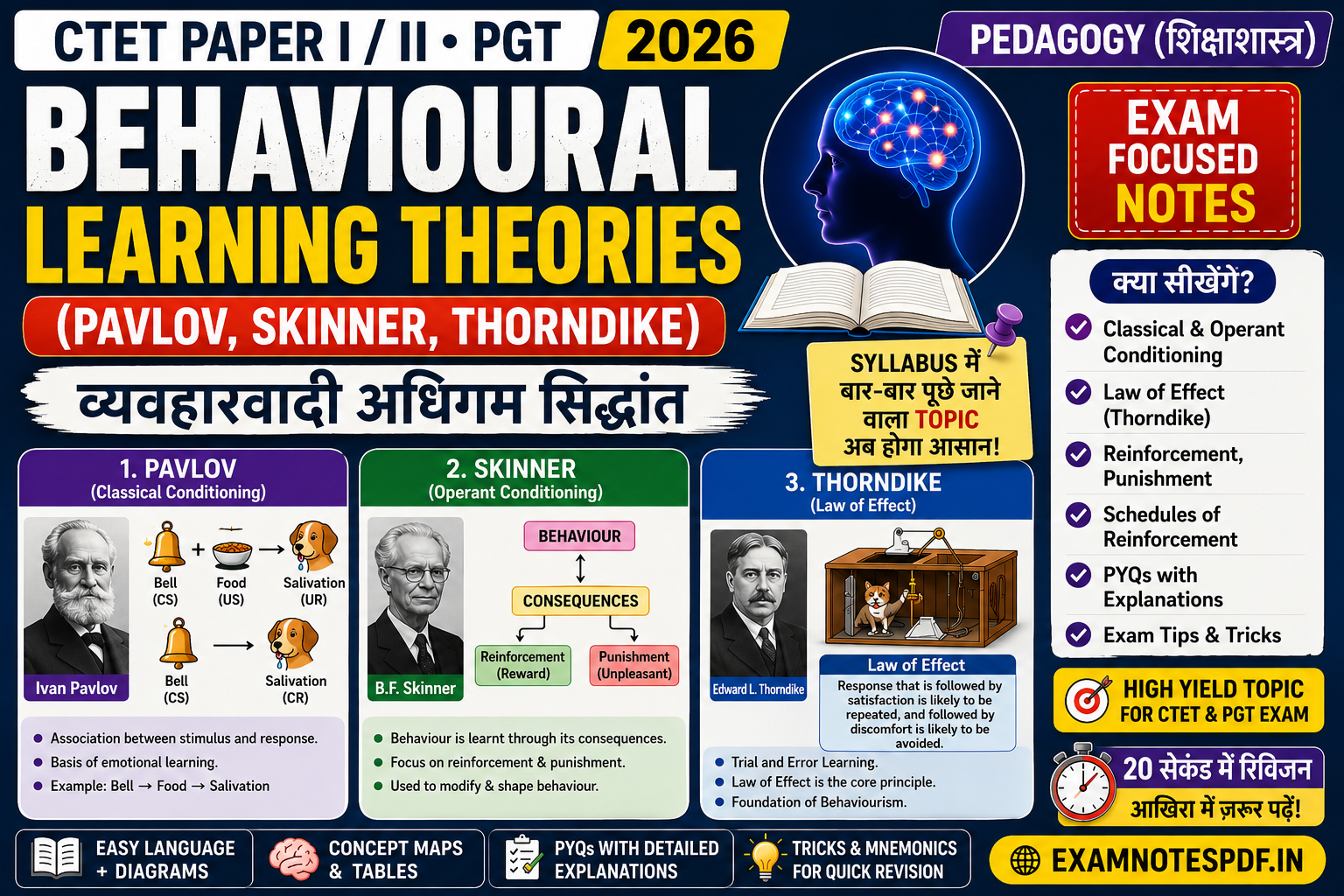
Behavioural Learning Theories CTET Notes 2026 CTET Paper I और Paper II के CDP section का ऐसा topic है जहाँ theory सीधी लगती है, लेकिन PYQ में statement-based confusion सबसे ज़्यादा यहीं होता है। अगर आप Pavlov, Skinner और Thorndike के laws, experiments, classroom application, reinforcement, punishment, trial and error, conditioning और exam traps को एक ही जगह clear करना चाहते हैं, तो यह notes आपके लिए है। इस guide को पढ़ने के बाद आपको पता होगा: → कौन-सा theorist क्या कहता है, statement देखकर theory कैसे पहचाननी है, और किसी भी MCQ में distractor को कैसे eliminate करना है। Read time लगभग 16 मिनट है—बीच के sections skip मत करना, क्योंकि CTET में छोटी line से पूरा question पलट जाता है।
Behavioural Learning Theories वे सिद्धांत हैं जो मानते हैं कि learning को observable behaviour के change से समझा जा सकता है। यानी learning का प्रमाण learner के अंदर क्या सोचा गया, यह नहीं; बल्कि बाहर क्या response बदला, यह है। CTET में यह topic मुख्यतः Pavlov — Classical Conditioning, Skinner — Operant Conditioning, और Thorndike — Trial and Error / Connectionism के माध्यम से पूछा जाता है।
Exam
Last 5 Years Trend
Estimated Weightage
CTET Paper I
Direct theorist-match, law-based MCQ, conditioning example
CTET में question अक्सर experiment नहीं, उसकी everyday example mapping पर आता है।
“Stimulus–Response”, “Reinforcement”, “Readiness”, “Law of Effect” — ये trigger words हैं।
Statement-based PYQ में Pavlov और Skinner को mix कर दिया जाता है।
Thorndike के laws से classroom drill, practice, motivation और readiness जुड़े रहते हैं।
Negative reinforcement और punishment का difference हर exam का favorite trap है।
🔥 PYQ Alert
Asked In: • CTET 2023 • KVS 2023 • DSSSB 2022
Actual PYQ pattern: “A child learns to associate school bell with lunch break excitement. This is an example of?”
Answer: Classical Conditioning
Reason: पहले neutral stimulus (bell) बाद में food/lunch excitement से associate होकर conditioned response पैदा करता है।
अगर exam आपसे पूछे कि बच्चा किसी चीज़ को देखकर अपने-आप reaction देने लगे, तो Pavlov याद करो। अगर पूछे कि बच्चा reward/punishment के कारण behaviour दोहराता या छोड़ता है, तो Skinner याद करो। और अगर पूछा जाए कि बच्चा कोशिश-दर-कोशिश सही उत्तर तक पहुँचता है, तो Thorndike याद करो। यही तीन-line shortcut आधे MCQ बचा देता है।
📦 Section Summary
✅ Behaviourism observable behaviour पर आधारित है ✅ CTET में 1–4 प्रश्न तक आ सकते हैं ✅ Pavlov, Skinner, Thorndike की पहचान line-triggers से करनी है
📘 Core Concept Notes
📘 Foundation Layer — CTET Paper I / PRT
Foundation level पर सवाल simple examples के through पूछा जाता है। जैसे बच्चा रोज़ school assembly की bell सुनकर line में खड़ा हो जाता है; dog food देखकर saliva छोड़ता है; बच्चा star मिलने पर homework time पर करने लगता है। यहाँ exam यह नहीं पूछता कि theory difficult है या नहीं। वह पूछता है कि कौन-सा example किस theory में fit बैठता है। NCERT-level understanding के लिए इसे daily routine behaviour से जोड़ना सबसे आसान है। NCERT EVS/primary classroom routines, rhymes, claps, stars, smileys, repetition — सब behaviourism से जोड़े जा सकते हैं।
💡 इसे ऐसे समझो
Class 4 के example से exam में ऐसा पूछा जा सकता है: “शिक्षक ने सही उत्तर पर ताली बजवाई, अब बच्चे और उत्साह से उत्तर देने लगे।” यह Skinner-type reinforcement है। “घंटी बजते ही बच्चे खाने की बात करने लगते हैं।” यह Pavlov-type association है। “Puzzle solve करते-करते बच्चा finally सही block fit कर देता है।” यह Thorndike-type trial and error है।
📘 Pavlov — Classical Conditioning
Ivan Pavlov ने बताया कि learning association के द्वारा भी होती है। उनके प्रसिद्ध experiment में dog को food दिया जाता था। Food एक Unconditioned Stimulus (UCS) था और saliva एक Unconditioned Response (UCR)। Bell शुरू में neutral stimulus थी, लेकिन बार-बार food के साथ pair होने के बाद वही bell Conditioned Stimulus (CS) बन गई, और bell सुनकर saliva आना Conditioned Response (CR) कहलाया। CTET में यह topic अक्सर stimulus labeling, example matching, और school routines के माध्यम से पूछा जाता है।
Ability
Description
🔑 Association
दो stimuli के repeated pairing से response बनना
🔑 Generalization
मिलते-जुलते stimulus पर भी same response होना
🔑 Discrimination
सिर्फ specific stimulus पर response देना
🔑 Extinction
जब conditioned stimulus अकेला बार-बार दिया जाए और response धीरे-धीरे खत्म हो जाए
🎯 Exam Point
Pavlov learning को association से जोड़ते हैं, reward से नहीं।
Classical conditioning mostly involuntary responses से जुड़ता है।
Fear learning, bell, smell, sound, routine cues — common examples हैं।
NCERT linkage: routine, school environment, sensory cues.
Expected MCQ stem: “Which concept explains learning by association of stimuli?”
⚠️ अक्सर होने वाली गलती
❌ Wrong: हर reward-based example को Pavlov मान लेना
✅ Correct: Pavlov में association है; reward-consequence pattern Skinner में जाता है
🧠 Memory Trick — Pavlov Conditioning Sequence
WHAT TO REMEMBER → UCS-UCR, NS + UCS, CS-CR → HOW TO RECALL → पहले natural, फिर pairing, फिर learned response → ⏱️ EXAM SPEED: 3s
🔒 यह Original Mnemonic — पूरा Memory Maps Collection में उपलब्ध है।
🔥 PYQ Alert
Asked In: • CTET 2022 • UPTET 2021 • KVS 2023
Actual PYQ stem: “School bell becoming a cue for students to pack bags is an example of?”
Answer: Conditioned response through classical conditioning
Reason: bell पहले neutral थी, repeated association के कारण learned cue बन गई।
Surprising fact + exam-solving trick… Pavlov digestive physiology के researcher थे; learning experiment उनकी original field नहीं थी। Exam trick: अगर question involuntary reaction, salivation, fear association, bell, sound cue बोले—Pavlov को पहले shortlist करो।
📘 Skinner — Operant Conditioning
B.F. Skinner के अनुसार behaviour अपने consequence के कारण strengthen या weaken होता है। यदि response के बाद pleasant consequence मिलता है, तो behaviour repeat होने की संभावना बढ़ती है। इसे reinforcement कहते हैं। यदि unpleasant consequence मिलता है और behaviour दबता है, तो punishment से जोड़ते हैं। Skinner का famous Skinner Box experiment rat/pigeon पर आधारित था, जहाँ lever press या key peck करके food मिलता था। CTET में reinforcement schedules से कम, basic positive-negative reinforcement और punishment difference से अधिक प्रश्न आते हैं।
Ability
Description
🔑 Positive Reinforcement
किसी behaviour के बाद pleasant stimulus देना ताकि behaviour बढ़े
🔑 Negative Reinforcement
अप्रिय स्थिति हटाना ताकि behaviour बढ़े
🔑 Punishment
Behaviour घटाने के लिए consequence देना
🔑 Shaping
Complex behaviour को step by step reinforce करके develop करना
Feature
Positive Reinforcement
Negative Reinforcement
Meaning
कुछ अच्छा जोड़ना
कुछ अप्रिय हटाना
Effect
Behaviour बढ़ता है
Behaviour बढ़ता है
Example
Correct answer पर star
Homework पूरा करने पर extra drill हटाना
Feature
Reinforcement
Punishment
Goal
Behaviour बढ़ाना
Behaviour घटाना
Exam Trap
Positive/negative शब्द से confuse होना
हर unpleasant event को punishment मान लेना
Core Rule
Behaviour probability increases
Behaviour probability decreases
🎯 Exam Point
Negative reinforcement punishment नहीं है।
Skinner voluntary behaviour पर अधिक focus करते हैं।
Programmed learning और teaching machines Skinner से जुड़े हैं।
CTET pedagogy में praise, token, feedback, drill, immediate reinforcement examples आते हैं।
Expected MCQ stem: “Which strategy increases desired behaviour by removing an aversive condition?”
WHAT TO REMEMBER → Positive reinforcement, Negative reinforcement, Punishment, Shaping → HOW TO RECALL → add/remove को behaviour increase/decrease से map करो → ⏱️ EXAM SPEED: 4s
🔒 यह Original Mnemonic — पूरा Memory Maps Collection में उपलब्ध है।
🔥 PYQ Alert
Asked In: • CTET 2021 • DSSSB 2023 • NVS 2022
Actual PYQ stem: “A child completes classwork to avoid extra homework. This is:”
Answer: Negative reinforcement
Reason: extra homework जैसी aversive condition हट रही है, इसलिए desired behaviour बढ़ रहा है।
Skinner के नाम के साथ “reinforcement schedule” भी जुड़ता है, लेकिन CTET में अधिकतर basic conceptual distinction पूछा जाता है, न कि advanced schedule taxonomy। इसलिए पहले reinforcement vs punishment और positive vs negative clear करो, बाद में detail पढ़ो।
📘 Thorndike — Trial and Error / Connectionism
Edward L. Thorndike ने learning को stimulus-response bonds के formation के रूप में समझाया। उनका प्रसिद्ध puzzle box experiment cat पर आधारित था। Cat कई गलत प्रयास करती है; अंत में सही latch दबाती है; repeated trials के बाद errors कम हो जाती हैं और सही response जल्दी आने लगता है। इसी से Trial and Error Learning और Law of Effect स्पष्ट हुआ। Thorndike के तीन मुख्य laws—Law of Readiness, Law of Exercise, और Law of Effect—CTET में बहुत frequent हैं।
Ability
Description
🔑 Law of Readiness
Learner तैयार हो तो learning बेहतर होती है
🔑 Law of Exercise
Practice से S-R bond मजबूत होता है
🔑 Law of Effect
Satisfying result behaviour को strengthen करता है
Feature
Trial and Error
Insight Learning
Process
Repeated attempts
Sudden understanding
Theorist
Thorndike
Kohler
Exam Use
Skill drill, maze, puzzle
Problem solving by grasping relations
🎯 Exam Point
Thorndike practice, readiness और satisfying consequence से learning समझाते हैं।
Law of Exercise को rote repetition तक सीमित मत समझो; repeated connection-building अधिक सही phrase है।
Primary classes में drill work, writing pattern practice, tables repetition—Thorndike link हो सकता है।
Expected MCQ stem: “A learner reaches correct response after several unsuccessful attempts. This is?”
NCERT linkage: foundational skills में repetition with meaning.
⚠️ ध्यान दें
❌ Wrong: Thorndike = only rote memorization
✅ Correct: Thorndike = connection formation through readiness, practice, and satisfying result
🧠 Memory Trick — Thorndike Main Laws
WHAT TO REMEMBER → Readiness, Exercise, Effect → HOW TO RECALL → पहले तैयार, फिर अभ्यास, फिर संतोषजनक परिणाम → ⏱️ EXAM SPEED: 2s
🔒 यह Original Mnemonic — पूरा Memory Maps Collection में उपलब्ध है।
🔥 PYQ Alert
Asked In: • CTET 2023 • REET 2022 • DSSSB 2021
Actual PYQ stem: “Learning to solve a problem after repeated attempts is closest to which theory?”
Answer: Trial and Error Learning
Reason: repeated attempts, error reduction, correct response selection — Thorndike indicators हैं।
Advanced level पर behaviourism की सबसे बड़ी limitation यह मानी गई कि यह internal mental processes को कम महत्व देता है। फिर भी modern educational technology, mastery learning, programmed instruction, behaviour modification, token economy, classroom routines, and immediate feedback systems में behaviourist principles आज भी heavily used हैं। PGT-level interpretation में answer balanced होना चाहिए: behaviourism is powerful for habit formation, drill, foundational response shaping; but insufficient alone for creativity, insight, and higher-order thinking.
📘 Exam में यह पूछा जाता है: एक Teacher को क्या करना चाहिए?
💡 Concept Clear करें
CTET में pedagogy angle यह नहीं पूछता कि केवल reward दो। वह पूछता है कि appropriate response क्या होगा। जैसे—desired behaviour बढ़ाने के लिए positive reinforcement, over-punitive classroom से बचना, meaningful practice देना, readiness का ध्यान रखना, और behaviour support को child-centred approach के साथ balance करना।
🎯 Exam Point
Constructivist approach कहेगा: केवल drill पर्याप्त नहीं; understanding भी जरूरी है।
Vygotsky angle: guided support + social interaction behaviour shaping से broader learning देता है।
Bloom mapping: remembering-level tasks में drill useful; applying/analyzing के लिए higher strategies जोड़नी होंगी।
Inclusive classroom: reward system humiliating नहीं होना चाहिए; public punishment avoid करें।
Common error: “discipline” के नाम पर harsh punishment चुन लेना—CTET में अक्सर गलत option यही होता है।
📘 Policy Connections
NCF 2005 ने learning को joyful, activity-based और fear-free बनाने पर जोर दिया। इसका मतलब यह नहीं कि reinforcement बेकार है; बल्कि reinforcement को supportive होना चाहिए, punitive नहीं। NEP 2020 foundational literacy-numeracy, competency-based learning और formative feedback पर जोर देती है; यहाँ immediate feedback behaviourist flavour रखता है, पर learner agency के साथ। RTE Act 2009 child dignity को protect करता है; इसलिए corporal punishment-based options exam में generally reject किए जाते हैं। NIPUN Bharat FLN goals में repetition, practice, assessment checkpoints उपयोगी हैं—यहाँ Thorndike और Skinner के selected principles practical value रखते हैं।
🔥 PYQ Alert
Asked In: • CTET 2023 • KVS 2022 • NVS 2021
Actual PYQ pattern: “Which classroom response is most appropriate to encourage desired behaviour?”
Best answer trend: Immediate positive feedback / constructive reinforcement
Reason: CTET punitive discipline की बजाय supportive, child-friendly, dignity-based options prefer करता है।
✅ CTET behaviourism को child-friendly pedagogy के साथ पूछता है ✅ punishment rarely best answer होता है ✅ readiness + feedback + dignity = safe exam formula
📘 Current Updates
📰 Updates Corner (Last 12–18 Months)
As reported by [NCF 2023 / Ministry of Education updates], competency-based and foundational learning emphasis continues in revised school discourse.
→ Exam Impact: rote drill alone as the “best pedagogy” option और भी कम सही माना जाएगा; feedback-based practice अधिक relevant रहेगी.
As reflected in FLN implementation under NIPUN Bharat, structured practice, small-step learning and progress monitoring are visible trends.
→ Exam Impact: Thorndike readiness/exercise और Skinner reinforcement examples practical classroom MCQ में फिर से दिख सकते हैं.
Recent board and policy discourse keeps child safety and dignity central.
→ Exam Impact: punishment-heavy options eliminate करने की आदत रखें.
📘 Deep Theory + Flowcharts
📘 Behaviourism की Theoretical Depth
Behaviourism का मूल मानना है कि learning को scientific, measurable और predictable तरीके से पढ़ा जा सकता है। इससे exams को objective MCQ बनाना आसान होता है, इसलिए teacher recruitment exams इसे बार-बार पूछते हैं। लेकिन three important nuance याद रखो। पहला, Pavlov involuntary associations पर अधिक focused हैं। दूसरा, Skinner response के बाद आने वाले consequences से behaviour modify करते हैं। तीसरा, Thorndike organism की repeated attempts से correct bond formation दिखाते हैं। इन तीनों में stimulus-response idea common है, पर learning mechanism अलग है। यही subtle difference objective paper की जान है।
💡 Doubt Clear करो
Question अगर कहे “automatic fear develops after repeated bad experience,” तो Pavlov line सोचो। अगर कहे “behaviour increases because of reward,” तो Skinner line। अगर कहे “child keeps trying different spellings and finally learns correct one,” तो Thorndike line। इसी तरह clue-word spotting practice से solving time बहुत घटता है।
Need / Situation ↓ Stimulus Presented ↓ Learner Responds ↓ Consequence or Association Forms ↓ Repetition / Strengthening ↓ Stable Learning
Behavioural Learning Theories
├── Classical Conditioning
│ ├── Pavlov
│ ├── Association
│ ├── Stimulus Pairing
│ └── Conditioned Response
├── Operant Conditioning
│ ├── Skinner
│ ├── Reinforcement
│ ├── Punishment
│ └── Shaping
└── Connectionism
├── Thorndike
├── Trial and Error
├── Law of Exercise
└── Law of Effect
🎓 PHD Teacher Insight
Modern psychology behaviourism को reject नहीं करती; बल्कि सीमित पर powerful tool मानती है। Behaviour modification, Applied Behaviour Analysis, token economy, habit training, classroom management, special education interventions—इन सब में behavioural ideas अभी भी उपयोगी हैं। लेकिन conceptual understanding, metacognition, creativity, and social meaning-making के लिए cognitive और constructivist approaches जोड़ना पड़ता है। इसलिए exam answer balanced होना चाहिए: “useful but not sufficient alone.”
📦 Section Summary
✅ तीनों theorists behaviour देखते हैं ✅ mechanism अलग है ✅ balanced answer exams में high accuracy देता है
📘 Comparison & Differentiation
Feature
Classical Conditioning
Operant Conditioning
Focus
Stimulus association
Consequence of response
Response Type
Mostly involuntary
Voluntary behaviour
Theorist
Pavlov
Skinner
Feature
Thorndike
Skinner
Core Idea
Trial and error, bond formation
Consequence-based behaviour shaping
Key Term
Law of Effect
Reinforcement
Classroom Link
Practice and drill
Feedback and reward systems
Pavlov Association Model
✅ Key Achievement: Neutral stimulus भी learned signal बन सकता है
❌ Limitation: Higher thinking and meaning-making explain नहीं करता
बहुत-से MCQ में सभी options partially सही लगते हैं। वहाँ best method है: पहले response type पहचानो—automatic, voluntary, या repeated attempts? यही single filter option elimination तेज़ करता है।
📦 Section Summary
✅ Compare by mechanism, not by theorist name only ✅ automatic vs voluntary vs trial-based filter use करो ✅ 3-column tables exam revision के लिए best हैं
📘 Mnemonics & Memory Architecture
🧠 Memory Trick — Pavlov Experiment Order
WHAT TO REMEMBER → Natural response → pairing → conditioned response → HOW TO RECALL → bell-food-saliva chain with visual cue → ⏱️ EXAM SPEED: 3s
🔒 यह Original Mnemonic — पूरा Memory Maps Collection में उपलब्ध है।
🧠 Memory Trick — Skinner Behaviour Outcomes
WHAT TO REMEMBER → positive reinforcement, negative reinforcement, punishment, shaping → HOW TO RECALL → add-remove plus increase-decrease grid → ⏱️ EXAM SPEED: 4s
🔒 यह Original Mnemonic — पूरा Memory Maps Collection में उपलब्ध है।
🧠 Memory Trick — Thorndike Main Laws Sequence
WHAT TO REMEMBER → Readiness, Exercise, Effect → HOW TO RECALL → ready learner practices and feels satisfaction → ⏱️ EXAM SPEED: 2s
🔒 यह Original Mnemonic — पूरा Memory Maps Collection में उपलब्ध है।
WHAT TO REMEMBER → Association, Consequence, Trial → HOW TO RECALL → clue-word spotting chain → ⏱️ EXAM SPEED: 2s
🔒 यह Original Mnemonic — पूरा Memory Maps Collection में उपलब्ध है।
🧠 Memory Trick — Visual Association Story: तीन दरवाज़ों वाला Lab
WHAT TO REMEMBER → Pavlov, Skinner, Thorndike in one story → HOW TO RECALL → bell room, reward room, puzzle room journey → ⏱️ EXAM SPEED: 6s
🔒 यह Original Mnemonic — पूरा Memory Maps Collection में उपलब्ध है।
🔓 इस Section के सभी 5 Mnemonics + Visual Story सिर्फ Memory Maps में उपलब्ध हैं → Memory Maps देखें
📘 Conclusion + Next-Topic Roadmap
📦 Section Summary
Behavioural Learning Theories CTET Notes 2026 का core takeaway बहुत सीधा है: Pavlov association समझाते हैं, Skinner consequences से behaviour shape करते हैं, और Thorndike repeated attempts से correct response strengthening दिखाते हैं। CTET Paper I और II में सही answer theorist के नाम से नहीं, बल्कि question के hidden clue से निकलता है। अगर आप response type, stimulus cue, consequence effect और trial-based pattern पहचानना सीख गए, तो इस topic के अधिकतर MCQ 10–15 सेकंड में solve हो सकते हैं। अब revision करते समय theory को classroom example और PYQ language से जोड़कर पढ़ें।
⚡ 20 Second Revision
• Pavlov = association of stimuli • Skinner = reinforcement/punishment • Thorndike = trial and error • Negative reinforcement ≠ punishment • Law of Effect = satisfying result strengthens response • CTET best options are child-friendly, not punitive
📘 Related Topics Roadmap
Now that you’ve mastered Behavioural Learning Theories, your next priority should be:
5. Learning Process & Principles
— क्योंकि Behaviourism learning process की foundational understanding पर आधारित है।
Study Time: 2.5 Hours
16. Teaching Methods & Classroom Management
— Reinforcement, Classroom Discipline, Behaviour Modification और Feedback के practical application को समझने के लिए।
Study Time: 2 Hours
What are Behavioural Learning Theories CTET Notes 2026 most likely to cover?
Pavlov, Skinner, Thorndike, Classical Conditioning, Operant Conditioning, Trial and Error Learning, Reinforcement, Punishment, important PYQs, classroom applications, and pedagogy-based concepts.
How are Behavioural Learning Theories useful for CTET Paper I & II?
Paper I generally asks concept-based and example-based MCQs, while Paper II focuses more on classroom application, pedagogy scenarios, and statement-based questions.
What is the difference between Classical and Operant Conditioning?
Classical Conditioning explains learning through stimulus association, whereas Operant Conditioning explains learning through consequences such as reinforcement and punishment.
Why is Thorndike important for CTET?
Thorndike’s Law of Readiness, Law of Exercise, and Law of Effect are among the most frequently tested concepts in CTET, DSSSB, KVS, and other teacher recruitment exams.
Is Negative Reinforcement the same as Punishment?
No. Negative Reinforcement increases behaviour by removing an unpleasant condition, whereas Punishment aims to reduce unwanted behaviour.
How many questions can come from Behavioural Learning Theories in CTET?
Based on previous exam trends, around 1–4 questions may appear directly or indirectly from Behavioural Learning Theories in the Child Development & Pedagogy section.