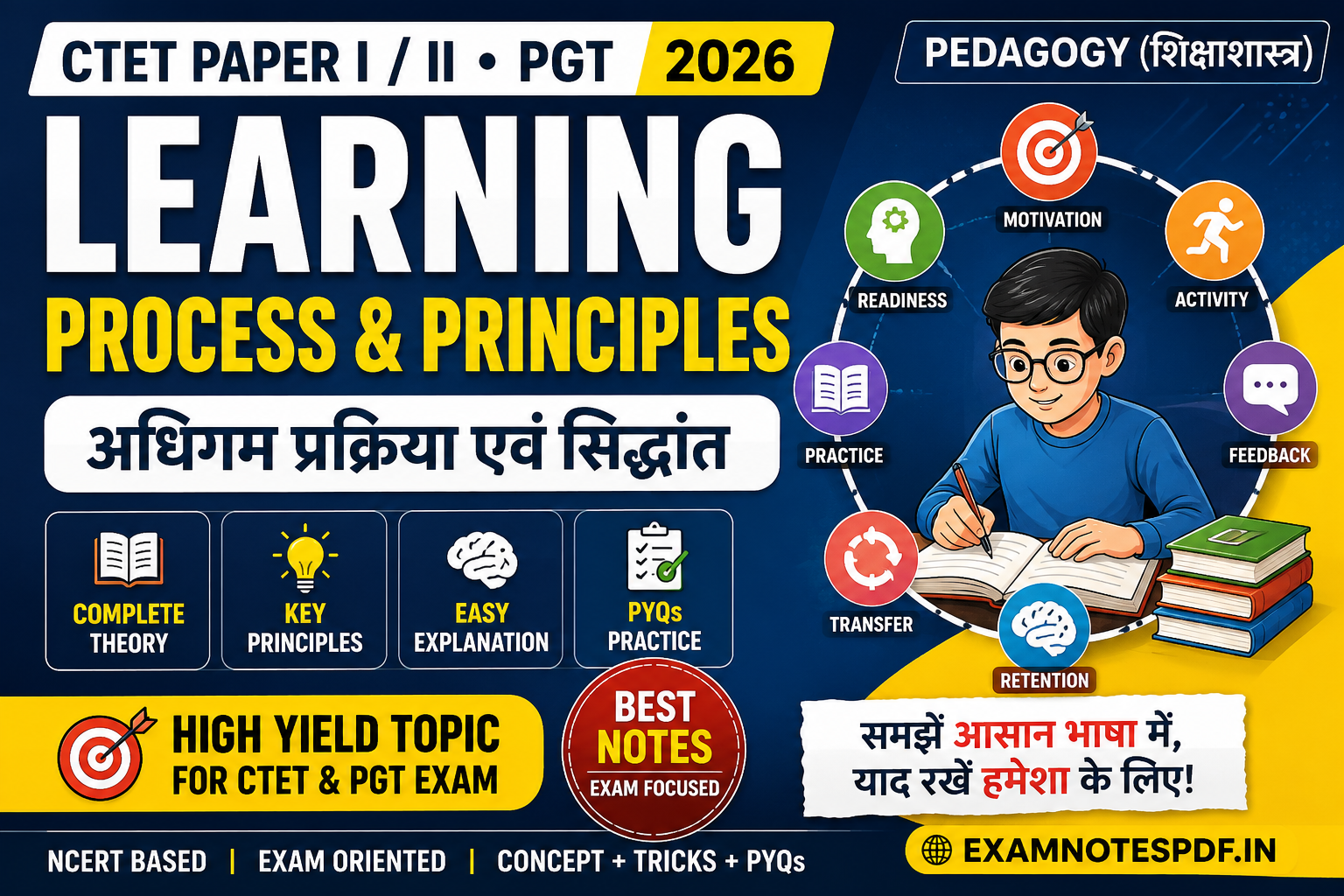
Learning Process and Principles CTET Notes 2026 pedagogy का ऐसा topic है जिससे सीधे conceptual MCQ, theory-based statements, psychologist-linked questions, और classroom application वाले प्रश्न बनते हैं। सबसे surprising बात यह है कि learning को सिर्फ “पढ़ना” समझ लेने वाले students सबसे ज़्यादा गलतियाँ यहीं करते हैं, क्योंकि exam learning को process, change in behaviour, experience-based modification, readiness, motivation, practice, transfer और reinforcement के angle से पूछता है। इस guide को पढ़ने के बाद आपको पता होगा: → learning process की exact meaning, learning principles के PYQ-level points, और किसी भी MCQ में सही option eliminate कैसे करना है। Read time लगभग 15–17 minutes है—skip मत करना, क्योंकि यही topic आगे theories, motivation, memory और pedagogy को जोड़ता है।
💡 इसे ऐसे समझो
Exam में learning का मतलब सिर्फ information लेना नहीं है। जब अनुभव, अभ्यास, interaction और environment के कारण behaviour, knowledge, skill, attitude या performance में relatively permanent change आता है, तब उसे learning कहा जाता है। इसी definition के words—experience, change, permanence, adaptation—से MCQ बनते हैं।
📘 Learning Process and Principles CTET Notes 2026 कितना Important है? — Exam Weightage
📘 Topic Snapshot
CTET Paper I/II और PGT Pedagogy में learning process foundational unit है। Behaviourism, Cognitivism, Constructivism, motivation, classroom management, evaluation—सभी इसी topic की base understanding पर खड़े हैं। अगर learning की nature और principles clear नहीं हैं, तो Thorndike, Skinner, Piaget, Vygotsky तक के questions weak हो जाते हैं।
| Exam |
Expected Weightage |
Question Form |
| CTET Paper I |
2–4 questions (estimated from trend) |
Definition, principle, child-centred application |
| CTET Paper II |
2–5 questions (estimated) |
Conceptual statement-based MCQ, pedagogy scenario |
| PGT |
3–6 questions (topic-linked) |
Theoretical distinction, psychologist linkage, implication |
🎯 Exam Point
- Learning is a process, not a one-time event.
- Practice, readiness, motivation, reinforcement, feedback, activity—ये repeated PYQ points हैं.
- CTET में statement-based options आते हैं: “Learning is maturation only” जैसे traps.
- PGT level पर learning के nature, transfer, individual differences, और formal-informal learning पूछे जाते हैं.
🔥 PYQ Alert
Asked In: • CTET • state pedagogy exams • PGT-type objective papers
Actual PYQ pattern: “Which of the following best describes learning?”
Answer: “A relatively permanent change in behaviour due to experience and practice.”
Reasoning: “Relatively permanent” + “experience” दोनों key terms हैं; temporary fatigue, growth, or maturation-only learning नहीं कहलाता।
📦 Section Summary
✅ Topic high-frequency है ✅ Learning की definition से सीधे MCQ बनते हैं ✅ This chapter is the base of later learning theories
📘 Core Concept Notes
📘 Definition
Learning is the process by which behaviour, knowledge, skill, attitude, or understanding changes in a relatively permanent way through experience, practice, observation, and interaction with the environment. यह change purposeful भी हो सकता है और incidental भी।
💡 आसान भाषा में समझें
अगर बच्चा साइकिल चलाना सीखता है, शुरुआत में गिरता है, फिर balance बना लेता है, बाद में लंबे समय तक skill maintain करता है—यह learning है। लेकिन अगर बुखार के कारण performance घट गई, तो वह learning नहीं। इसलिए exam में याद रखें: हर change learning नहीं होता। Experience-based meaningful change ही learning है। NCERT child development chapters और foundational pedagogy इसी distinction पर ज़ोर देते हैं।
🎯 Exam Point
- Learning may be formal, informal, non-formal.
- Learning can be cognitive, affective, psychomotor.
- Learning is influenced by readiness, motivation, reinforcement, environment, health, intelligence.
- Learning is not equal to mere maturation, though maturation supports learning.
- Learning is continuous from womb to tomb.
- Learning may be desirable or undesirable; bad habits भी learned हो सकते हैं.
| Ability |
Description |
| 🔑 Cognitive Learning | Knowledge, concept, reasoning, problem-solving से जुड़ा learning. |
| 🔑 Affective Learning | Attitude, values, interest, emotions में change. |
| 🔑 Psychomotor Learning | Skill, coordination, action-based performance जैसे writing, drawing, lab work. |
⚠️ अक्सर होने वाली गलती
❌ Wrong: Growth, maturation, fatigue, injury से आया हर change learning है.
✅ Correct: केवल experience/practice/interaction से आया relatively lasting change learning है.
🧠 Memory Trick — Features of Learning
WHAT TO REMEMBER → continuous, change, experience, goal-directed, universal, adaptation, permanence → MNEMONIC (चलो अच्छे गुरु पढ़ाएँ) → HOW TO RECALL → first image = child moving from raw action to refined response → ⏱️ EXAM SPEED: 4s
🔒 यह Original Mnemonic — पूरा Memory Maps Collection में उपलब्ध है।
🔥 PYQ Alert
Asked In: • CTET • PGT pedagogy • TET variants
Actual PYQ stem: “Learning is best described as—”
Answer: “Modification of behaviour through experience.”
1-line reasoning: जिन options में heredity-only, maturation-only, or temporary change दिया हो, उन्हें eliminate करें।
💡 Did You Know?
Surprising fact + exam-solving trick…
Thorndike के laws और general principles of learning में overlap दिखता है, इसलिए examiner कई बार direct law नहीं लिखता, सिर्फ situation देता है—student must identify readiness, exercise, effect, motivation, or feedback indirectly.
📘 Learning Process: चरणबद्ध समझ
Learning process को कई writers अलग तरह से explain करते हैं, लेकिन exam use के लिए इसे broadly ऐसे समझें: Need/Goal → Motivation → Readiness → Practice/Experience → Reinforcement/Feedback → Retention → Transfer. यह exact process-oriented view CTET pedagogy questions में useful है क्योंकि option में कभी “punishment,” कभी “rote repetition,” कभी “child’s active participation” आ सकता है।
Need / Goal ↓ Motivation ↓ Readiness ↓ Active Experience / Practice ↓ Feedback & Reinforcement ↓ Retention ↓ Transfer to New Situation
🎯 Exam Point
- Readiness के बिना learning forced हो जाती है.
- Motivation learning को start और sustain करती है.
- Practice skill refinement के लिए essential है.
- Feedback error correction कराता है.
- Transfer बताता है कि सीखी हुई बात नई situation में लागू हो रही है या नहीं.
💡 Concept Clear करें
CTET Paper I level पर इसे Class 4 example से पूछा जा सकता है: बच्चा fractions तभी बेहतर सीखेगा जब उसे prior knowledge of parts, interest, concrete material और repeated activity मिले। यही readiness + activity + reinforcement का combined application है। Paper II/PGT में यही idea abstract form में पूछा जाता है: “Learning is facilitated when the learner is actively engaged.”
| Feature |
Learning |
Maturation |
| Meaning | Experience-based change | Biological growth-based readiness |
| Source | Practice, environment, interaction | Innate developmental pattern |
| Example | Writing better after practice | Speaking ability emerging with age |
| Feature |
Formal Learning |
Informal Learning |
| Setting | School/institution | Home, peers, society |
| Structure | Planned and curricular | Unplanned, natural |
| Outcome | Certified competence | Life adaptation and behaviour |
🎓 PHD Teacher Insight
Advanced psychology में learning को केवल observable behaviour तक सीमित नहीं माना जाता। Contemporary view इसे
information processing, schema modification, self-regulation, metacognition, socio-cultural participation, and identity formation से जोड़ता है। इसलिए PGT level questions में pure behaviouristic answer कई बार incomplete होता है। अगर option में active meaning-making, prior knowledge integration, social mediation और reflective correction एक साथ दिखें, तो वही higher-order answer होता है।
📘 Principles of Learning
Different books principle list को थोड़ा vary करती हैं, लेकिन exam-ready master list में सामान्यतः ये points आते हैं: readiness, motivation, goal orientation, activity, exercise/practice, effect/reinforcement, feedback, association, repetition with meaning, transfer, individual differences, and environment. याद रखें—principles rigid commandments नहीं हैं; ये learning को facilitate करने वाले broad conditions हैं।
| Ability |
Description |
| 🔑 Readiness | Learner mentally/physically prepared हो तो learning easier होती है. |
| 🔑 Motivation | Interest or drive learning को शुरू और sustain करता है. |
| 🔑 Practice | Repetition with understanding skill को strong बनाती है. |
| 🔑 Reinforcement | Satisfying consequences correct response को strengthen करते हैं. |
| 🔑 Feedback | Learner को error और progress की जानकारी मिलती है. |
⚠️ ध्यान दें
❌ Wrong: ज़्यादा repetition अपने-आप effective learning दे देगी.
✅ Correct: Meaningful, goal-linked, feedback-supported practice ही strong learning देती है.
🧠 Memory Trick — Major Principles of Learning
WHAT TO REMEMBER → readiness, motivation, goal, activity, exercise, effect, feedback, association, transfer, differences, environment → MNEMONIC (रमा गोल आँगन…) → HOW TO RECALL → imagine a learner entering a prepared room and moving through action to transfer → ⏱️ EXAM SPEED: 5s
🔒 यह Original Mnemonic — पूरा Memory Maps Collection में उपलब्ध है।
🔥 PYQ Alert
Asked In: • CTET • PGT • pedagogy objective tests
Actual PYQ pattern: “Which principle of learning is reflected when a child learns best after receiving immediate knowledge of results?”
Answer: Feedback / reinforcement principle
1-line reasoning: immediate result awareness error correction को accelerate करती है।
NCERT linkage के लिए foundational pedagogy और school learning discussion देखें। Related conceptual support आपको Constructivism and Child-Centred Learning Notes, Behavioural Learning Theories Notes, और Assessment and Evaluation Notes जैसे topics में मिलेगा। Official framing of learner-centred pedagogy के लिए NCF 2005 Position Paper और policy shift समझने के लिए NEP 2020 useful हैं।
📦 Section Summary
✅ Learning = experience-based relatively permanent change ✅ Process words are exam gold ✅ Principles of learning are asked directly and through situations
📘 Exam में यह पूछा जाता है: एक Teacher को क्या करना चाहिए?
📘 Pedagogy Core
CTET/KVS type questions में examiner सीधे पूछता है कि learning को effective बनाने के लिए teacher का approach क्या होना चाहिए। सही answer प्रायः वही होगा जिसमें active participation, prior knowledge, social interaction, feedback, inclusion, diagnostic correction, और meaningful tasks शामिल हों। rote lecture-only approach प्रायः distractor बनती है।
💡 Doubt Clear करो
यह section आपको teaching tips देने के लिए नहीं है; exam answer identify कराने के लिए है। अगर question में लिखा हो कि class में students concept नहीं समझ रहे, तो best answer अक्सर वह होगा जिसमें concrete material, peer discussion, scaffolding, diagnostic feedback, और multiple examples हों।
🎯 Exam Point
- Piaget link: child learns actively by constructing knowledge.
- Vygotsky link: social interaction and scaffolding improve learning.
- Bloom link: remember → understand → apply → analyse progression.
- Inclusive angle: same content, varied support; not one rigid method for all.
- Assessment angle: formative assessment gives feedback during learning.
🔥 PYQ Alert
Asked In: • CTET pedagogy
Actual PYQ stem: “A teacher can facilitate learning best by—”
Answer: engaging learners in meaningful activities connected to prior knowledge.
1-line reasoning: constructivist, learner-centred, experience-based option usually correct होता है।
| Pedagogy Situation |
Weak Response |
Best Exam Response |
| Low interest | More punishment | Motivating activity + relevance |
| Frequent errors | Label child weak | Feedback + remedial help |
| Different pace | One method for all | Differentiated support |
🎓 PHD Teacher Insight
NEP 2020 competency-based learning model में learning outcomes observable performance तक सीमित नहीं, बल्कि understanding, application और problem-solving तक फैले हैं। इसलिए exam में वह option strong माना जाता है जिसमें students explanation दे सकें, transfer कर सकें, reflect कर सकें, not merely recall facts.
📰 Policy Connections
NCF 2005 learner-centred, activity-based, fear-free learning पर जोर देता है। NEP 2020 foundational literacy-numeracy, competency-based learning, experiential pedagogy और multilingual access को support करता है। RTE 2009 child-friendly and child-centred education को reinforce करता है। NIPUN Bharat primary level learning outcomes and foundational engagement पर focus करता है।
📦 Section Summary
✅ Teacher-role questions में learner-centred option देखें ✅ Feedback + activity + inclusion high-value clues हैं ✅ Policy language अक्सर distractor eliminate कराती है
📘 Current Updates Injection
📰 Updates Corner (Last 12–18 Months)
As reported by NCERT and Ministry documents, NCF-aligned school education revisions continue to push competency-based and experiential learning language in textbooks and teacher discourse.
→ Exam Impact: direct “rote vs competency” MCQs बढ़ने की संभावना।
As reflected in FLN implementation under NIPUN Bharat, early grade learning is being tracked through foundational outcomes.
→ Exam Impact: primary pedagogy questions में readiness, activity, and assessment-for-learning को जोड़कर पूछा जा सकता है।
NEP-driven assessment reforms continue to favour application and understanding over memorisation.
→ Exam Impact: “best learning situation” type options में active construction वाले choices stronger रहेंगे।
💡 Exam की एक दिलचस्प बात
Current affairs यहाँ dates याद करने के लिए नहीं, language पहचानने के लिए काम आते हैं। अगर option में competency-based, experiential, multilingual support, formative feedback जैसे words हों, तो recent policy climate के कारण वे अक्सर stronger options होते हैं।
📦 Section Summary
✅ Recent policies rote से competency की तरफ shift दिखाती हैं ✅ FLN language important है ✅ Policy vocabulary सीधे MCQ elimination में मदद करती है
📘 Deep Theory + Flowcharts
📘 Nature of Learning
Learning की nature पर questions statement form में आते हैं। Key propositions याद रखें: learning is universal, continuous, adaptive, purposive, active, social-context influenced, and variable across individuals. यह cumulative भी होती है—new learning old experience पर build करती है। इसलिए prior knowledge pedagogy का central point बनता है। Learning overt भी हो सकती है और covert भी; some changes immediately visible नहीं होते, but performance later reveal करती है।
🎯 Exam Point
- Universal: every individual learns.
- Continuous: life-long process.
- Purposeful: linked with needs and goals.
- Active: learner participation matters.
- Social: environment and interaction shape outcomes.
- Individualized: pace and style differ.
Need arises ↓ Goal becomes clear ↓ Motivation activates effort ↓ Learner engages with task ↓ Practice refines response ↓ Feedback corrects errors ↓ Retention stabilizes learning ↓ Transfer proves true learning
💡 Simple Trick से समझें
अगर transfer नहीं हुआ, तो examiner कई बार learning को incomplete मानता है। उदाहरण: बच्चा class में formula repeat कर ले, पर नए question में apply न कर पाए—यह shallow learning है। PGT level पर यही understanding vs rote distinction critical है।
⚠️ यहाँ Students गलती करते हैं
❌ Wrong: Learning = memorisation only.
✅ Correct: Learning includes understanding, skill, attitude, application, adaptation.
Learning
├── By Setting
│ ├── Formal
│ ├── Informal
│ └── Non-formal
├── By Domain
│ ├── Cognitive
│ ├── Affective
│ └── Psychomotor
└── By Outcome
├── Desirable
└── Undesirable
🔥 PYQ Alert
Asked In: • CTET • PGT
Actual PYQ pattern: “Which statement about learning is incorrect?”
Answer approach: वह statement चुनें जो learning को fixed, passive, maturation-only, or teacher-dominated बताती हो।
Reasoning: modern pedagogy learning को active, developmental and contextual मानती है।
🧠 Memory Trick — Nature of Learning
WHAT TO REMEMBER → universal, continuous, active, social, purposive, individual, adaptive → MNEMONIC (उज्ज्वल चिड़िया…) → HOW TO RECALL → seven moving stations from child to society → ⏱️ EXAM SPEED: 4s
🔒 यह Original Mnemonic — पूरा Memory Maps Collection में उपलब्ध है।
📦 Section Summary
✅ Nature statements MCQ में frequently आती हैं ✅ Transfer true understanding का test है ✅ Classification-based elimination बहुत useful है
<!– Paste your Google AdSense / code here –>
📘 Comparison & Differentiation Tables
| Feature |
Learning |
Performance |
| Nature | Relatively permanent change | Immediate observable output |
| Stability | Lasting tendency | May vary by mood/health |
| Exam Use | Conceptual answer | Distractor in many MCQs |
| Feature |
Rote Learning |
Meaningful Learning |
| Basis | Mechanical repetition | Understanding and linkage |
| Retention | Often fragile | More stable |
| Transfer | Low | High |
Formal Learning (institution based)
✅ Key Achievement: Structured knowledge and certification
❌ Key Limitation: May become rigid if child participation is low
🎓 Exam Method: Often compared with informal and non-formal learning
Informal Learning (life based)
✅ Key Achievement: Natural adaptation through family, peers, media, society
❌ Key Limitation: Not systematically organized
🎓 Exam Method: Asked via examples like language habits, manners, social behaviour
Non-formal Learning (organized but flexible)
✅ Key Achievement: Need-based learning outside formal school system
❌ Key Limitation: Limited standardization in many contexts
🎓 Exam Method: Open schooling, adult literacy, bridge courses examples
Learning Timeline in Exam Thinking
Need sensed ↓ Interest generated ↓ Readiness checked ↓ Experience / activity ↓ Practice ↓ Feedback ↓ Retention ↓ Transfer / application
⚠️ ध्यान दें
❌ Wrong: अच्छा performance दिखा तो learning निश्चित है.
✅ Correct: performance temporary factors से भी affect होती है; learning relatively stable change है.
📦 Section Summary
✅ Learning vs performance और learning vs maturation सबसे important pairs हैं ✅ Formal-informal examples से direct MCQ बनते हैं ✅ Comparison tables fast revision देते हैं
🧠 Mnemonics & Memory Architecture
🔒 Premium Memory Maps Preview
इस Topic के सभी Premium Mnemonics, Visual Stories और Quick Recall Maps नीचे दिए गए हैं।
- 🧠 Process Chain of Learning
- 🧠 Domains of Learning
- 🧠 Conditions Favouring Learning
- 🧠 Learning Types by Setting
- 🎨 Visual Association Story
Preview
Mnemonic → Story → Recall Steps → Exam Speed → Visual Memory Maps → PYQ Connections
📦 Section Summary
✅ Lists and sequences memory tricks से 3–5 second recall में आते हैं ✅ Only mnemonic payload locked है, theory free है ✅ Fast recall objective exams में decisive advantage देता है
📘 Conclusion + Next-Topic Roadmap
📦 Section Summary
Learning Process and Principles CTET Notes 2026 का core message यह है कि learning को process, change, readiness, motivation, practice, feedback और transfer के integrated रूप में समझना होगा। अगर आप सिर्फ definition याद करेंगे, तो statement-based MCQ में फँसेंगे। लेकिन अगर आपने learning vs maturation, learning vs performance, formal vs informal, और learner-centred pedagogy की logic पकड़ ली, तो CTET Paper I/II और PGT के अधिकांश questions आसानी से निकलेंगे। इस topic को mastery level पर समझना आगे की theories और pedagogy sections को भी आसान बना देता है।
⚡ 20 Second Revision
• Learning = relatively permanent change due to experience • Maturation supports but is not learning • Readiness + motivation + practice + feedback = strong learning • Transfer proves depth • Learner-centred options usually win in pedagogy MCQs • Rote ≠ meaningful learning
📘 Related Topics Roadmap
Now that you’ve mastered Learning Process & Principles, your next priority should be:
- 6. Behavioural Learning Theories — क्योंकि Readiness, Exercise, Effect, Reinforcement जैसे principles वहीं और गहराई से समझाए जाते हैं। Study Time: 2.5 Hours
- 7. Cognitive Learning Theories — क्योंकि Active Learning, Meaning-Making, Schema, Discovery Learning और Scaffolding इसी topic का logical extension हैं। Study Time: 3 Hours
- 15. Assessment & Evaluation — क्योंकि Feedback, Retention, Transfer of Learning तथा Learning Outcomes को measure करना assessment का मुख्य उद्देश्य है। Study Time: 2 Hours
यदि आप इस topic को और गहराई से समझना चाहते हैं, तो
NCERT के Learning chapters,
Ministry of Education की policy documents,
NIPUN Bharat Mission,
NEP 2020,
NCF 2005,
और
NCF 2023
का अध्ययन करें।
Recommended Study Path:
Behavioural Learning Theories
→
Cognitive Learning Theories
→
Constructivism & Child-Centred Learning
→
Assessment & Evaluation.