HomeFree NotesTeaching Methods and Classroom Management CTET Notes 2026:…
Teaching Methods and Classroom Management CTET Notes 2026: Best Complete Guide
Added 12 Jul 2026 9 min read0% completed ·
Continue ReadingWhere you left off
Teaching Methods and Classroom Management CTET Notes 2026 — शिक्षण विधियाँ एवं कक्षा प्रबंधन
Teaching Methods and Classroom Management CTET Notes 2026 — शिक्षण विधियाँ एवं कक्षा प्रबंधन
📖 Estimated Read Time: 14–17 minutes • 🔥 4,800+ words • ✅ CTET Paper I & II • 🎯 2026
Teaching Methods and Classroom Management CTET Notes 2026 — यह Topic CTET Paper I और Paper II दोनों में CDP (Child Development & Pedagogy) सेक्शन का सबसे high-weightage area है। पिछले 5 सालों के PYQ analysis के अनुसार, Teaching Methods और Classroom Management से 26–40% तक questions आते हैं — यानी 30 questions में से 8–12 questions सीधे इसी Topic से पूछे जाते हैं[reference:0]। इस guide को पढ़ने के बाद आपको पता होगा: → (1) सभी important teaching methods का exam-oriented classification, (2) classroom management के core principles और discipline strategies, (3) PYQs में पूछे गए हर type के MCQ को solve करने का exact approach।
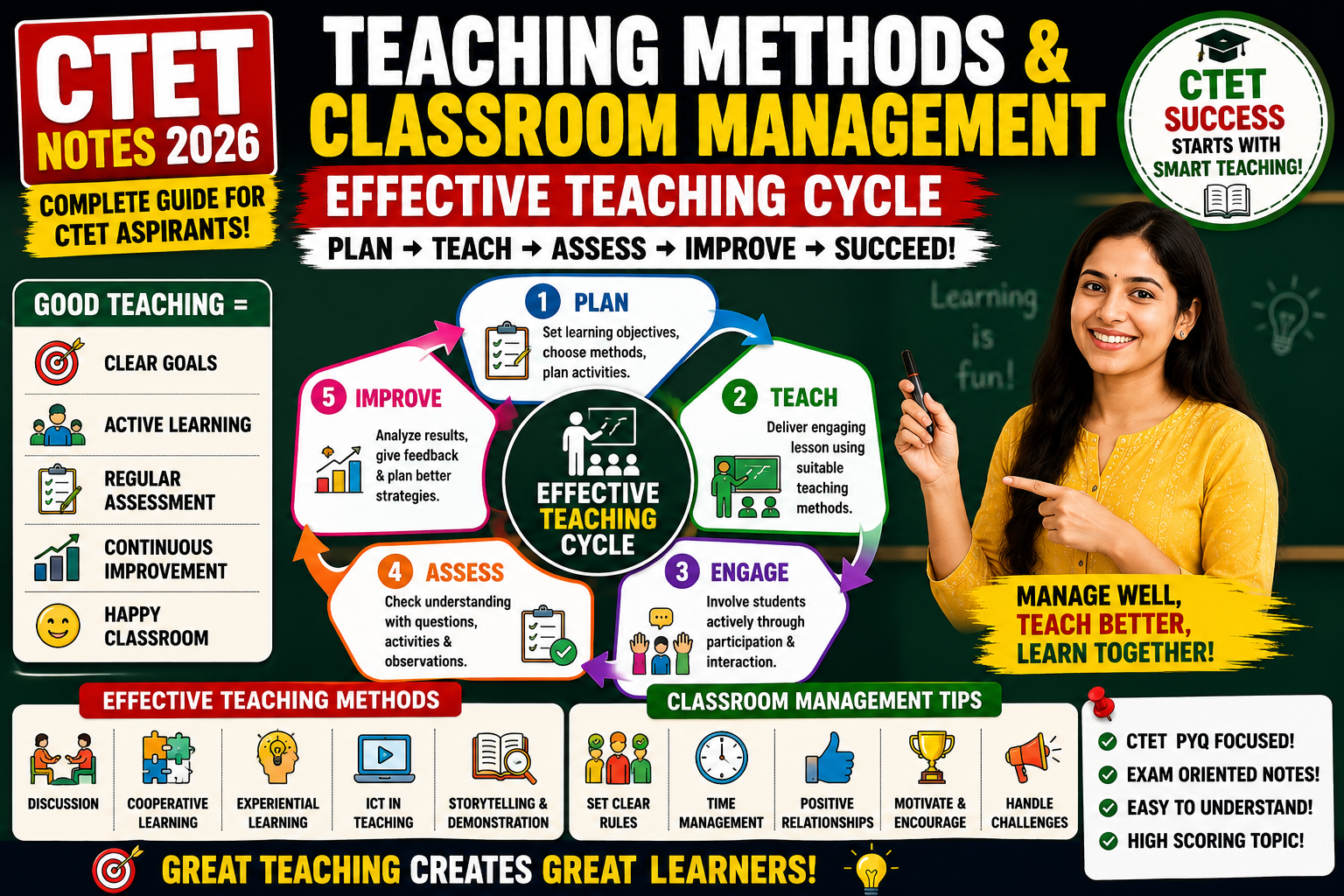
Effective Teaching Cycle Flowchart for Teaching Methods and Classroom 📘 Teaching Methods & Classroom Management कितना Important है? — Exam Weightage
📊 Exam Weightage — Real Data
Exam
Questions from this Topic
Weightage
CTET Paper I (2021–2025)
8–10 questions
~27–33%
CTET Paper II (2021–2025)
9–12 questions
~30–40%
KVS / NVS / DSSSB
6–8 questions
~20–27%
💡 CTET 2026 के लिए: Teaching Methods और Classroom Management से 30 में से कम से कम 10 questions आने की उम्मीद है[reference:1]। यह Topic आपका score make या break कर सकता है — इसे skip करना मतलब 10+ marks गँवाना।
💡 आसान भाषा में समझें
Teaching Method = वह तरीका जिससे Teacher बच्चों को पढ़ाता है (जैसे — Lecture, Discussion, Activity)। Classroom Management = वह सारी strategies जिनसे Teacher class को disciplined, engaging और productive बनाए रखता है। CTET में दोनों को एक साथ पूछा जाता है — क्योंकि बिना effective classroom management के कोई भी teaching method fail हो जाता है।
📘 Core Teaching Methods — सभी महत्वपूर्ण शिक्षण विधियाँ
📘 Definition — Teaching Method
Teaching Method वह systematic way है जिसके through teacher students को learning objectives तक पहुँचाता है। इसमें principles, procedures और techniques शामिल होते हैं[reference:2]। Teaching method का चुनाव subject matter और learner की nature दोनों पर depend करता है[reference:3]।
🔹 Teaching Methods का Classification — Exam के लिए MUST KNOW
Category
Methods
Key Feature
Teacher-Centred
Lecture, Demonstration, Drill
Teacher is active; students are passive receivers
Learner-Centred
Project, Problem-Solving, Discovery, Discussion
Students are active; teacher is facilitator[reference:4]
Inductive
Examples → Rule/Generalization
Specific to general[reference:5]
Deductive
Rule → Examples/Applications
General to specific[reference:6]
🎯 Exam Point — Learner-Centred vs Teacher-Centred
CTET 2019 PYQ: “Use of methods where learner’s own initiative and efforts are involved, is an example of:” → Answer: Learner-centred method[reference:7]
CTET Philosophy: NEP 2020 और NCF 2005 learner-centred, activity-based, experiential learning को prefer करते हैं[reference:8]। CTET में हमेशा learner-centred option को correct मानें — जब तक question explicitly otherwise न कहे।
🔥 PYQ Alert — Teaching Methods
CTET Paper I — 3rd Jan 2022: “To gain cooperation of students in classroom management, a teacher should:”[reference:9]
Options: (a) Establish strict and rigid classroom rules herself (b) Frequently complain to parents about students’ misbehavior (c) Reprimand the students for not following the rule (d) Establish norms and rules for classroom in collaboration with students
✅ Correct Answer: (d) — क्योंकि NCF 2005 participatory management और student collaboration पर जोर देता है[reference:10]। बच्चों के साथ rules बनाने से वे उन rules को own करते हैं और cooperation बढ़ती है[reference:11]।
✅ Teaching Method = way of presenting content + facilitating learning ✅ Learner-centred > Teacher-centred (CTET philosophy) ✅ Project, Discussion, Discovery = most preferred ✅ Inductive (example→rule) vs Deductive (rule→example) — दोनों के differences याद रखें
📘 Classroom Management — कक्षा प्रबंधन के Principles & Strategies
📘 Definition — Classroom Management
Classroom Management वह organizational function है जिसके through teacher planning, organizing, coordinating, directing और controlling करता है ताकि effective learning environment बन सके[reference:15]। CTET में Classroom Management से discipline, student cooperation, seating arrangement, time management सब कुछ cover होता है[reference:16]।
💡 Concept Clear करें — Classroom Management के 4 Pillars
Engagement & Participation: Activities, discussions, group work
🔹 Effective Classroom Management की Strategies — CTET में हर साल पूछी जाती हैं
Strategy
What it means
CTET Keyword
Collaborative Rule-Making
Rules बच्चों के साथ मिलकर बनाएँ
“in collaboration with students”[reference:20]
Positive Reinforcement
Good behaviour को encourage करें
“applause”, “encourage”[reference:21]
Activity-Based Engagement
Students को meaningful work दें
“engaged in teaching activity”[reference:22]
Respect & Empathy
Teacher का behaviour positive हो
“intimacy and sympathy”[reference:23]
🎯 Exam Point — Discipline & Cooperation
Discipline का सबसे effective तरीका: Students को meaningful activities में engage करना[reference:24] — न कि threat या punishment[reference:25]
Classroom management में सबसे बड़ा role:Class Teacher का[reference:26] — Principal या Inspector नहीं
Cooperation gain करने का best way:norms and rules को students के साथ collaboration में establish करना[reference:27]
🔥 PYQ Alert — Classroom Management
CTET Paper I — 2017 (similar): “Who is mainly responsible for classroom management?”[reference:28]
Options: (a) Principal (b) Class-teacher (c) Students (d) Inspector/Supervisor
✅ Correct Answer: (b) Class-teacher — क्योंकि classroom management की primary responsibility class teacher की होती है। Principal और Inspector administrative level पर होते हैं।
Another PYQ: “For healthy arrangement of classroom, necessary thing is:”[reference:29] ✅ Answer: (d) All of the above — sufficient light, ventilated classroom, appropriate seating arrangement — तीनों ज़रूरी हैं।
CTET में हर pedagogy question का आधार:बच्चा active learner है, teacher facilitator है — यह philosophy NCF 2005 और NEP 2020 दोनों में common है[reference:34]
🎓 PHD Teacher Insight — Constructivism in Classroom Management
Vygotsky का ZPD (Zone of Proximal Development) सिर्फ learning तक सीमित नहीं है — यह classroom management पर भी apply होता है। Teacher को scaffolding provide करनी चाहिए ताकि students gradually self-regulation सीखें। CTET में questions आते हैं: “Teacher को classroom rules कैसे introduce करने चाहिए?” — Answer: Gradually, with student input, और age-appropriate language में।
💡 क्या आपको पता है?
NEP 2020 के अनुसार, FLN (Foundational Literacy & Numeracy) के लिए activity-based और play-based teaching methods सबसे suitable हैं[reference:35]। CTET 2026 में FLN से जुड़े questions आ सकते हैं — “FLN program focuses much on the methods used in the classroom for teaching. What are the best suitable methods?” — Answer: Activity-based, experiential, and play-based methods.
📰 Updates Corner (Last 12–18 Months)
As reported by Ministry of Education, January 2026: CTET 2026 syllabus में NEP 2020 और NCF 2023 के pedagogical principles को और अधिक importance दी गई है[reference:36]। → Exam Impact: Teaching Methods और Classroom Management के questions में activity-based learning, experiential learning, और inclusive classroom strategies पर focus बढ़ेगा।
📘 Current Updates — NEP 2020, NCF 2023 & FLN
📰 Updates Corner
NEP 2020 — Experiential Learning: “Students should learn through doing, discovery, and discussion” — इसका सीधा असर CTET questions पर[reference:37]
NCF 2023 — Pedagogical Shift:Competency-based education और holistic development पर focus — teaching methods को outcome-based बनाना[reference:38]
FLN Mission — NIPUN Bharat: Class 1–3 के लिए play-based, activity-based, और experiential teaching methods recommended[reference:39]
RTE Act 2009 — Inclusive Classroom:Every child (including CWSN) को quality education — classroom management में inclusive strategies ज़रूरी[reference:40]
📘 Deep Theory + Flowcharts & Comparison Tables
🔹 Master Flowchart — Effective Teaching का पूरा Cycle
Planning (Lesson Plan + Objectives) ↓ Selecting Teaching Method (Learner-Centred vs Teacher-Centred) ↓ Classroom Setup (Physical Environment + Rules) ↓ Delivery (Engaging, Interactive, Activity-Based) ↓ Assessment (Formative + Summative) ↓ Feedback & Adaptation (Adjust methods based on student response)
🔹 Comparison Table — Teaching Methods (CTET में सबसे ज़्यादा पूछा जाता है)
Aspect
Teacher-Centred
Learner-Centred
Role of Teacher
Active — delivers content
Facilitator — guides learning[reference:41]
Role of Student
Passive — receiver
Active — constructor of knowledge
Examples
Lecture, Drill, Demonstration
Project, Discussion, Discovery
CTET Preference
Less preferred
Highly preferred (NEP 2020)
🔹 Classification Tree — Teaching Methods
Teaching Methods ├── On basis of Role │ ├── Teacher-Centred (Lecture, Demonstration, Drill) │ └── Learner-Centred (Project, Discussion, Discovery, Problem-Solving) ├── On basis of Logic │ ├── Inductive (Examples → Rule) │ └── Deductive (Rule → Examples) └── On basis of Interaction ├── One-way (Lecture) ├── Two-way (Discussion, Question-Answer) └── Multi-way (Group Work, Project)
💡 Did You Know?
Inductive और Deductive method CTET में अक्सर पूछे जाते हैं। Inductive = “examples देखो → rule खोजो” (specific to general)[reference:42]। Deductive = “rule दो → examples लगाओ” (general to specific)[reference:43]। Exam Trick: जब question में “examples”, “observation”, “particular to general” आए → Inductive। जब “rule”, “principle”, “general to particular” आए → Deductive।
📘 Mnemonics & Memory Architecture
🧠 इस Topic के सभी Mnemonics
🔒Teaching Methods ClassificationTLC IDP…
🔒Classroom Management 4 PillarsPREP…
🔒Inductive vs Deductive DifferenceEDGE…
🎬Visual Association Story — Classroom Managementएक teacher…
🔓 इस Topic के सभी 3 Mnemonics + Visual Story सिर्फ Memory Maps में उपलब्ध हैं → Memory Maps देखें
📘 Conclusion + Next-Topic Roadmap
📦 Section Summary
✅ Teaching Methods = strategies to deliver content — Learner-Centred > Teacher-Centred (CTET philosophy) ✅ Classroom Management = physical environment + rules + relationships + engagement — Class Teacher is primary responsible ✅ NEP 2020 & NCF 2005 = activity-based, experiential, constructivist approach — CTET हर pedagogy question का आधार ✅ Exam Strategy: हर MCQ में learner-centred, collaborative, activity-based option को correct मानें — यह CTET का “positive tag word” है[reference:44]
⚡ 20 Second Revision — Teaching Methods & Classroom Management
Now that you’ve mastered Teaching Methods & Classroom Management, your next priority should be:
15. Assessment & Evaluation — Teaching methods के बाद assessment आता है — CTET में teaching method और assessment को साथ पूछा जाता है। Study Time: 2.5 Hours
5. Learning Process & Principles — Teaching methods का psychological base — Learning process को समझे बिना methods का selection सही नहीं हो सकता। Study Time: 2 Hours
9. Motivation, Attention & Interest — Classroom management में student engagement का core — Motivation के बिना कोई method effective नहीं। Study Time: 1.5 Hours
Teaching Methods और Classroom Management को और गहराई से समझने के लिए NEP 2020 और NCF 2005 के Pedagogy sections ज़रूर पढ़ें।
What is the most important teaching method for CTET?
CTET learner-centred methods को सबसे ज़्यादा importance देता है — विशेष रूप से Project Method, Discussion Method, और Discovery Method। NEP 2020 और NCF 2005 दोनों activity-based और experiential learning को prefer करते हैं[reference:45]。
Who is responsible for classroom management in CTET?
CTET के अनुसार, classroom management के लिए Class Teacher मुख्य रूप से responsible है[reference:46]। Principal और Inspector administrative level पर होते हैं, लेकिन classroom की daily management class teacher की ज़िम्मेदारी है。
How to gain cooperation of students in classroom management?
CTET PYQ के अनुसार, cooperation gain करने का best way है — norms और rules को students के साथ collaboration में establish करना[reference:47]। Strict rules जो teacher खुद बनाता है, negative environment create करते हैं[reference:48]。
What is the difference between inductive and deductive teaching methods?
Inductive Method = examples से rule तक पहुँचना (specific to general)[reference:49]। Deductive Method = rule को examples पर apply करना (general to specific)[reference:50]। CTET में दोनों के differences अक्सर पूछे जाते हैं。
CTET Paper 1 (Class 1–5) के लिए activity-based, play-based, और experiential methods सबसे suitable हैं[reference:52]। NEP 2020 के FLN program के अनुसार, play-way method, project method, और discovery method को प्राथमिकता दी जानी चाहिए[reference:53]。
What does NEP 2020 say about teaching methods?
NEP 2020 experiential learning, discovery-oriented, और discussion-based approach को prioritise करता है[reference:54]। Teacher को facilitator की भूमिका निभानी चाहिए, न कि only knowledge provider[reference:55]。