Inclusive Education CTET Notes 2026 — समावेशी शिक्षा
Inclusive Education CTET Notes 2026 — समावेशी शिक्षा
Inclusive Education CTET Notes 2026 — यह CDP का सबसे high-weightage topic है, जिससे CTET Paper 1 और Paper 2 दोनों में 5 questions पूछे जाते हैं। KVS, NVS, DSSSB, UPTET, BPSC TRE सभी exams में इस topic से 4–6 questions आते हैं।
📖 इस guide को पढ़ने के बाद आपको पता होगा: → समावेशी शिक्षा की exact definition और उसके principles • CWSN (Children with Special Needs) की सभी categories और उनकी identification • Inclusive classroom में कौन-सी strategies काम आती हैं • CTET में पूछे गए सभी PYQs का pattern और correct approach • NEP 2020, NCF 2005, RTE Act 2009 से जुड़े सभी exam-relevant points। ⏱️ पढ़ने का समय: 14–16 मिनट — पूरा पढ़ें, कोई section skip न करें क्योंकि हर line exam में काम आती है।
📑 Table of Contents
- समावेशी शिक्षा कितनी Important है? — Exam Weightage
- Core Concepts — समावेशी शिक्षा की Foundation से Advanced तक
- Exam में यह पूछा जाता है — Pedagogy & Policy Angle
- Current Updates — NEP 2020, NCF 2023, Recent Initiatives
- Deep Theory + Flowcharts — समावेशी शिक्षा का पूरा Framework
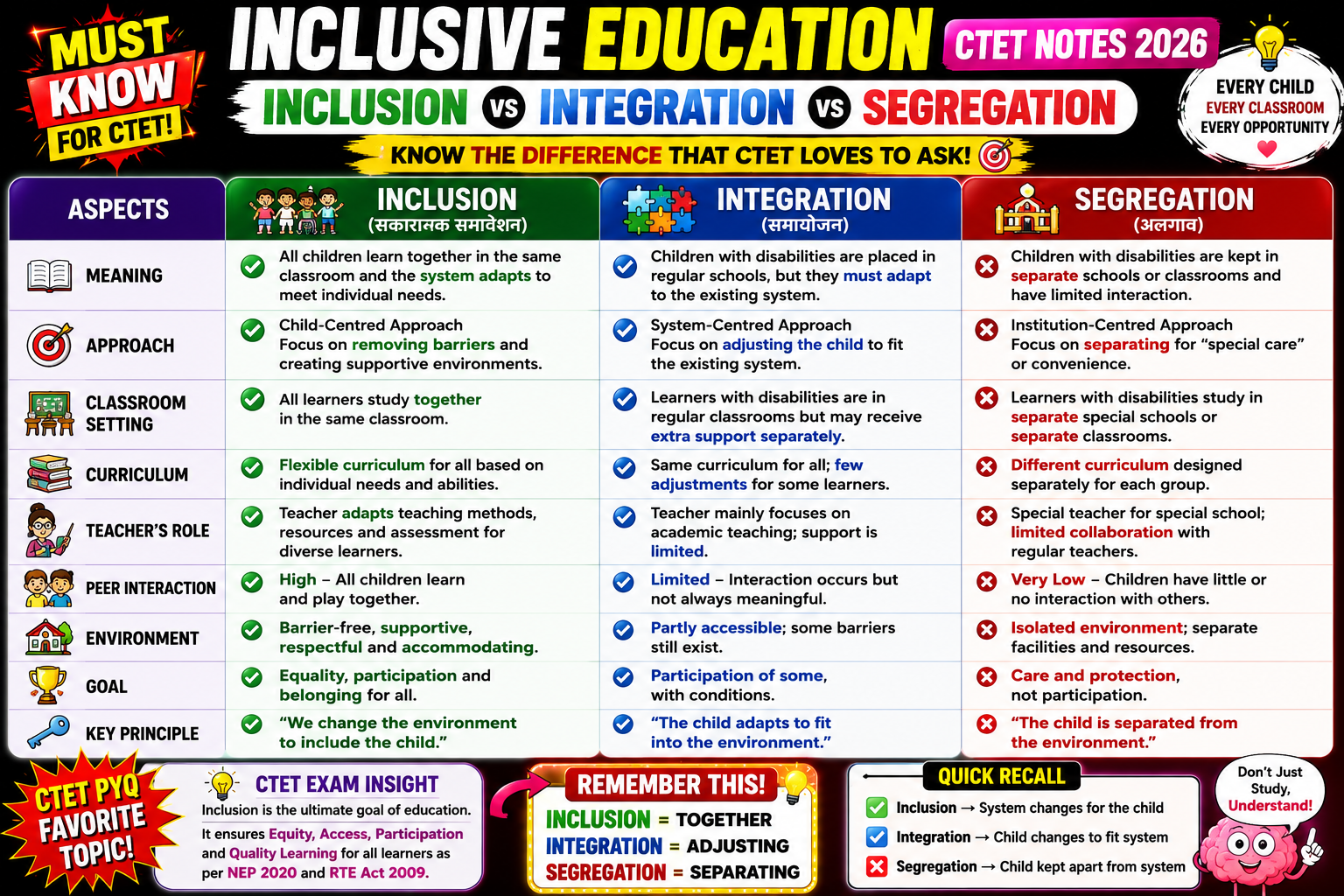
- Comparison Tables — Inclusion vs Integration vs Segregation
- Mnemonics & Memory Architecture
- Conclusion + Next-Topic Roadmap
- Frequently Asked Questions — Inclusive Education CTET Notes 2026
📘 समावेशी शिक्षा कितनी Important है? — Exam Weightage
Inclusive Education CTET Notes 2026 के इस सेक्शन में सबसे पहली बात — CTET में इस topic से हर Paper में 5 questions आते हैं। यानी CDP के 30 questions में से 16.6% weightage सिर्फ इस एक topic का है। Paper 1 (Class 1–5) और Paper 2 (Class 6–8) दोनों में यही pattern है।
| Exam | Questions from Inclusive Education | Weightage |
|---|---|---|
| CTET Paper 1 | 5 | 16.6% of CDP |
| CTET Paper 2 | 5 | 16.6% of CDP |
| KVS / NVS / DSSSB | 4–6 | 12–20% of Pedagogy |
| UPTET / BPSC TRE | 4–5 | ~15% of CDP |
- CTET में 5 questions — “Concept of Inclusive Education and understanding children with special needs”
- Syllabus keywords: “Addressing learners from diverse backgrounds including disadvantaged and deprived” + “Addressing the needs of children with learning difficulties, impairment etc.” + “Addressing the Talented, Creative, Specially abled Learners”
- Most asked: Definition of inclusion vs integration, types of disabilities, teacher’s role in inclusive classroom, RTE Act 2009 provisions
🧠 Memory Trick available: “समावेशी शिक्षा के 5 Core Principles” — Mnemonics section में देखें
📘 Core Concepts — समावेशी शिक्षा की Foundation से Advanced तक
🔹 Layer 1 — Foundation (CTET Paper 1 / PRT Level)
Inclusive Education CTET Notes 2026 की foundation यह है — समावेशी शिक्षा सिर्फ “दिव्यांग बच्चों” तक सीमित नहीं है। इसमें सभी प्रकार की diversity शामिल है — caste, gender, religion, language, community, economic background, learning style।
🔹 Layer 2 — Intermediate (TGT / CTET Paper II Level)
Inclusive Education का मतलब है — सभी learners की diverse needs को address करना, participation बढ़ाना और exclusion कम करना। यह एक process है, एक बार का काम नहीं।
- Impairment (अक्षमता): शारीरिक/संवेदी/बौद्धिक क्षति — जैसे आँखों की रोशनी कम होना
- Disability (विकलांगता): impairment के कारण किसी activity को करने में limitation — जैसे पढ़ने में कठिनाई
- Handicap (अभाग्य): social/environmental barrier — जैसे स्कूल में ramp न होना
- CTET में अक्सर पूछा: इन तीनों में difference और examples
🔹 Layer 3 — Advanced (PGT / KVS PGT Level)
Inclusive Education CTET Notes 2026 में यह advanced point याद रखें — UDL (Universal Design for Learning): एक ऐसा curriculum जो सभी learners के लिए accessible हो, बिना किसी को अलग करने की ज़रूरत पड़े।
Answer: is supportive, non-judgmental, and provides equal opportunities to participate
Reasoning: Disadvantaged बच्चों को extra emotional और academic support चाहिए — inclusive classroom exactly यही provide करता है।
📘 Exam में यह पूछा जाता है — Pedagogy & Policy Angle
🔹 3A. Teacher का Role — CTET Pedagogy Questions
- ✅ Diversity को accept और value करना
- ✅ Children की socio-cultural background को pedagogic resource के रूप में use करना
- ✅ Cooperative learning और peer tutoring को encourage करना
- ✅ Flexible curriculum और differentiated instruction का use करना
- ✅ All students can learn — यह belief होना चाहिए
- ❌ Special children को “normal” से segregate करना
- ❌ किसी भी बच्चे को label करना
- ❌ “ये बच्चे नहीं पढ़ सकते” — ऐसा attitude
Options:
a) “Good, it will provide a good opportunity for children to learn to help each other and be supportive” ✅
b) “Such children should go to special schools where they will learn better” ❌
c) “Oh! How can I teach children who cannot even read?” ❌
d) “I’m worried that my class may not accept these children…” ❌
Reasoning: Inclusive education का मूल — सभी बच्चों का स्वागत, support और participation।
🔹 3B. Policy Connections — NCF 2005, NEP 2020, RTE Act 2009
- 6–14 साल के सभी बच्चों को free & compulsory education — Fundamental Right (Article 21A)
- Neighbourhood school में inclusive education — schools को barrier-free बनाना mandatory
- 25% reservation — private unaided schools में EWS और disadvantaged groups के लिए
- CWSN को inclusive setup में पढ़ना चाहिए, provisions के साथ
- Equitable and Inclusive Education — dedicated chapter
- RTE का extension — 18 years तक
- SEDGs (Socially and Economically Disadvantaged Groups) पर special focus
- Gender Inclusion Fund और Special Education Zones
- Flexible curriculum और early identification of disabilities
- No discrimination — teacher को कभी discriminate नहीं करना चाहिए
- Inclusive quality education — equity के साथ
- Child-centred और progressive education
🧠 Memory Trick available: “RTE Act 2009 की 4 Key Provisions” — Mnemonics section में देखें
📢 **AD SLOT** — insert here, after Section 3, before Section 4: “`html “`📘 Current Updates — NEP 2020, NCF 2023, Recent Initiatives
→ Exam Impact: NEP 2020 से जुड़े MCQs में वृद्धि — “RTE extension to 18 years” और “SEDGs” पर questions आ सकते हैं
🔹 NCF 2023: NEP 2020 के अनुरूप — competency-based, flexible curriculum, inclusive pedagogy पर focus
→ Exam Impact: “NCF 2023 में inclusive education को कैसे address किया गया है?” — यह type का question आ सकता है
🔹 RTE Act Amendment: 1 special educator per 10 CWSN (Class 1–5) और 1 per 15 CWSN (Class 6–8)
→ Exam Impact: Teacher-student ratio for CWSN — numerical question आ सकता है
🔹 Samagra Shiksha 2.0: SEDGs के लिए dedicated resources
→ Exam Impact: “Samagra Shiksha का inclusive education में क्या role है?” — यह पूछा जा सकता है
📘 Deep Theory + Flowcharts — समावेशी शिक्षा का पूरा Framework
🔹 Types of Disabilities — CTET में कौन-सी आती हैं?
- Complete absence of sight
- Vision less than 3/60 or 10/200 (Snellen)
- Reduced field of vision (<10 degrees)
- Slight: 26–40 dB loss
- Moderate: 41–60 dB loss
- Severe: 61–80 dB loss
- Profound: 81+ dB loss
- Stammering (हकलाना)
- Shuttering
- Pronunciation defect
- Defect in sentence structure
- Dyslexia — पढ़ने में कठिनाई
- ADHD — ध्यान और hyperactivity की समस्या
- Autism — social interaction और communication में चुनौती
↓
Barriers Identify करें (Physical • Attitudinal • Curriculum • Assessment)
↓
Policy Support (RTE Act 2009 • NEP 2020 • NCF 2005/2023)
↓
Strategies Apply करें (Differentiated Instruction • Co-teaching • Assistive Technology • Flexible Curriculum)
↓
Outcome — Sabhi learners participate करें, सीखें, और अपनी full potential तक पहुँचें
🧠 Memory Trick available: “Disability Types की 4 Categories” — Mnemonics section में देखें
📘 Comparison Tables — Inclusion vs Integration vs Segregation
| Feature | Segregation (अलगाव) | Integration (एकीकरण) | Inclusion (समावेशन) |
|---|---|---|---|
| Philosophy | “बच्चे को बदलो” | “बच्चे को adapt होना पड़ेगा” | “System को बदलो” |
| Setting | Special schools (अलग) | Regular classroom में रखा, but support limited | Regular classroom + full support |
| Curriculum | Modified/alag | Same — बच्चे को follow करना पड़ता है | Flexible — सभी के लिए accessible |
| Focus | Disability पर | Child को “normal” बनाना | Barriers हटाना |
| CTET में Answer | ❌ Wrong | ❌ (पुराना approach) | ✅ Correct |
Options:
a) Do we believe that all students can learn? ✅
b) Do we work in teams to plan and deliver learning enabling environment? ✅
c) Do we properly segregate special children from normal to provide better care? ❌
d) Do we adopt strategies catering for the diverse needs of students? ✅
Answer: Option C
Reasoning: Inclusive school कभी segregation नहीं करता — “सभी को साथ” यही inclusion है।
📘 Mnemonics & Memory Architecture
📘 Conclusion + Next-Topic Roadmap
- 13. Children with Special Needs — विशेष आवश्यकता वाले बच्चे — Inclusive Education के बाद सबसे close topic — CWSN की specific categories और उनकी needs detail में समझें। Study Time: 2.5 Hours
- 14. Learning Disabilities — अधिगम अक्षमताएँ — Dyslexia, ADHD, Autism — CTET में इनसे 2–3 questions आते हैं। Inclusive Education का practical application यहाँ समझ आता है। Study Time: 2 Hours
- 15. Assessment & Evaluation — आकलन एवं मूल्यांकन — Inclusive classroom में assessment कैसे करें? — CCE, formative/summative, और diverse learners के लिए assessment strategies। Study Time: 2 Hours
Inclusive Education को और गहराई से समझने के लिए NEP 2020 के Equitable and Inclusive Education chapter और RTE Act 2009 के provisions देखें।
Recommended Study Path: Growth & Development → Principles & Stages → Factors Affecting Development → Inclusive Education.
❓ Frequently Asked Questions — Inclusive Education CTET Notes 2026
1. Inclusive Education CTET Notes 2026 में कौन-से topics cover करने हैं?
CTET syllabus के अनुसार — Concept of Inclusive Education, understanding children with special needs, addressing learners from diverse backgrounds (disadvantaged, deprived, learning difficulties, impairment, talented, creative, specially abled)।
2. CTET में Inclusive Education से कितने questions आते हैं?
CTET Paper 1 और Paper 2 दोनों में 5 questions — CDP के 30 questions में से 16.6% weightage।
3. Inclusive Education और Integrated Education में क्या difference है?
Integration: बच्चे को regular classroom में रखा जाता है, लेकिन उसे adapt होना पड़ता है। Inclusion: system को बच्चे के अनुसार बदला जाता है — flexible curriculum, differentiated instruction, co-teaching।
4. RTE Act 2009 Inclusive Education से कैसे connected है?
RTE Act 2009 — 6–14 साल के सभी बच्चों को free & compulsory education, neighbourhood school में inclusive education, 25% reservation for EWS, CWSN को inclusive setup में पढ़ना।
5. NEP 2020 Inclusive Education के लिए क्या provisions देता है?
Equitable and inclusive education पर dedicated chapter, RTE extension to 18 years, SEDGs पर special focus, Gender Inclusion Fund, Special Education Zones, flexible curriculum।
6. Inclusive classroom में teacher की क्या role होनी चाहिए?
Diversity को accept और value करना, socio-cultural background को pedagogic resource के रूप में use करना, cooperative learning और peer tutoring को encourage करना, flexible curriculum और differentiated instruction का use करना।
7. Impairment, Disability और Handicap में क्या difference है?
Impairment: शारीरिक/संवेदी क्षति (जैसे आँखों की रोशनी कम)। Disability: impairment के कारण activity में limitation (जैसे पढ़ने में कठिनाई)। Handicap: social/environmental barrier (जैसे स्कूल में ramp न होना)।
8. Inclusive Education की मुख्य strategies क्या हैं?
Differentiated Instruction, Collaborative Teaching (Co-teaching), Flexible Grouping, Assistive Technology, Ongoing Assessment।