Children with Special Needs CTET Notes 2026 — विशेष आवश्यकता वाले बच्चे
Children with Special Needs CTET Notes 2026 — विशेष आवश्यकता वाले बच्चे
Children with Special Needs CTET Notes 2026 CTET के CDP section का ऐसा topic है जहाँ direct definition-based, application-based, inclusion-based और pedagogy-based प्रश्न बार-बार पूछे जाते हैं। सबसे बड़ी बात यह है कि यहाँ students अक्सर disability, disorder, impairment, inclusion, mainstreaming, integration और accommodation जैसे terms को mix कर देते हैं। यही confusion exam में गलत answer दिलवाता है। इस guide को पढ़ने के बाद आपको पता होगा: → कौन-से बच्चे CWSN category में आते हैं, inclusive classroom में teacher का सही approach क्या होना चाहिए, और किसी भी MCQ में correct pedagogical option कैसे चुनना है। पढ़ते समय कोई section skip मत कीजिए, क्योंकि CTET Paper I और Paper II दोनों में यही linked understanding marks दिलाती है.
एक surprising fact यह है कि exam में “special need” हमेशा severe disability का नाम नहीं होता; कई बार gifted child, learning difficulty, sensory loss, behavioural issue, slow learner, autism spectrum, ADHD, cerebral palsy, hearing impairment जैसे cases broader educational support की demand करते हैं। इसलिए सिर्फ medical label याद करना काफी नहीं है; exam pedagogy पूछता है कि child के learning right को कैसे protect किया जाए।
📑 Table of Contents
📘 Children with Special Needs कितना Important है? — Exam Weightage
| Exam | Approx. Questions | Trend |
|---|---|---|
| CTET Paper I | 1–3 | Inclusive education, identification, classroom adaptation |
| CTET Paper II | 2–4 | Learning disability, pedagogy, child rights, case-based MCQ |
| TGT Level | 2–5 | Disability categories, inclusion strategies, policy link |
- CTET में direct पूछा जाता है कि special need child के लिए best classroom response क्या होगा.
- Most common traps: pity-based approach, segregation, same test for all, punishment for disability-linked behaviour.
- Paper II में case study style question आता है: “A child in your class…” और options में pedagogy test होती है.
- Children with Special Needs CTET Notes 2026 type topics में rights-based approach medical approach से ज्यादा important होती है.
Actual PYQ stem: “Inclusive education implies that children with disabilities should be educated…”
Answer: With other children in regular schools with required support.
Reasoning: Inclusion means participation in common classroom with adaptations, not isolation.
📘 Core Concept Notes — Children with Special Needs CTET Notes 2026
- Special need = extra educational support need, not only “disability certificate”.
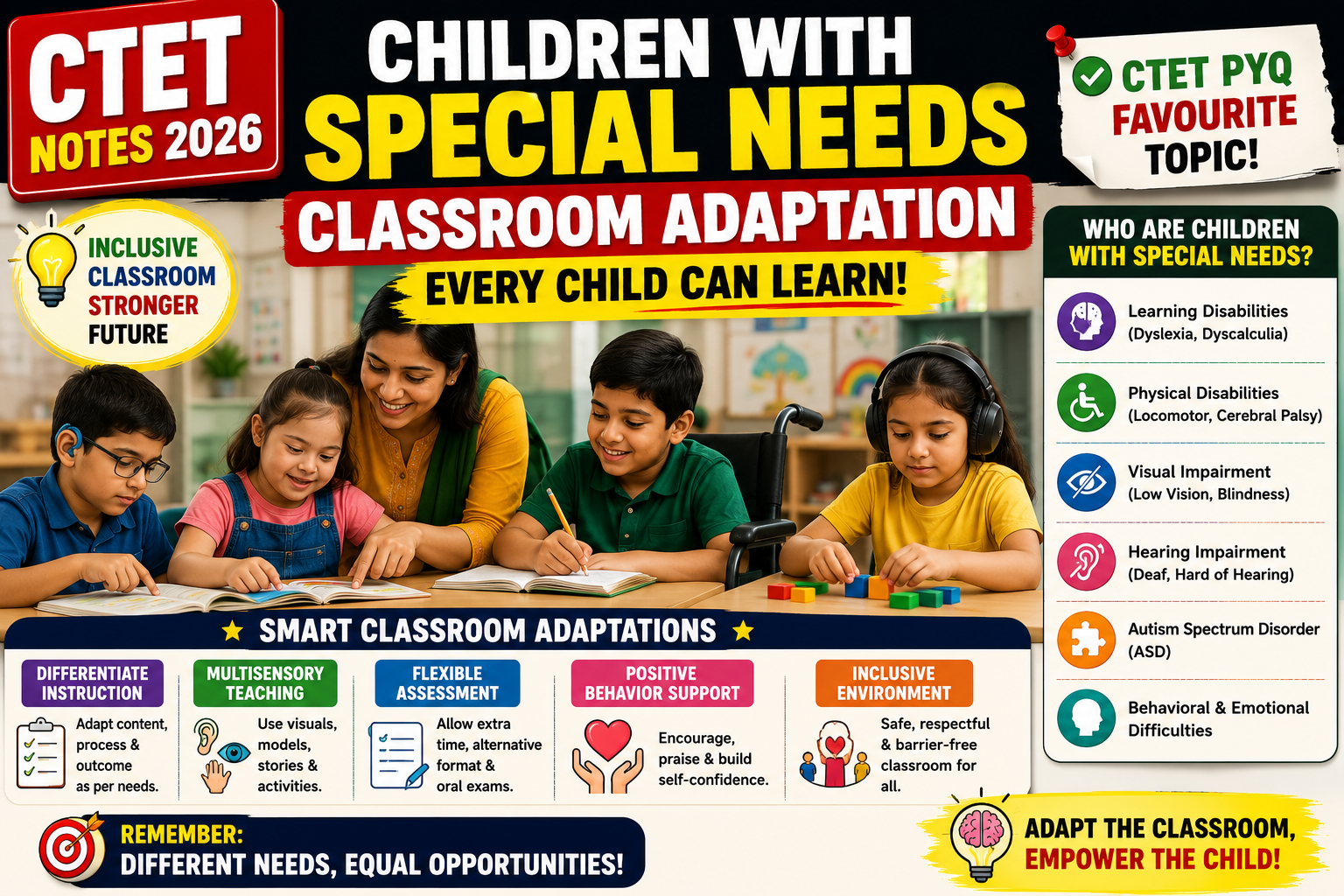
- Categories broadly include: visual impairment, hearing impairment, locomotor disability, intellectual disability, autism spectrum disorder, learning disability, ADHD, speech-language difficulty, cerebral palsy, multiple disabilities, giftedness.
- Exam में “best teaching strategy” usually child-centred, flexible, supportive, non-discriminatory होती है.
- NCERT reference: Class 12 Education/Psychology related inclusion concepts; elementary pedagogy link through diversity and inclusion.
- Expected MCQ stem: “A child who needs additional support for participation in regular classroom is called…”
🧠 Memory Trick available: “Major CWSN Categories” — Mnemonics section में देखें
Layer 1 — Foundation (CTET Paper I / PRT): छोटे level पर question यह पूछा जा सकता है कि classroom में अगर कोई बच्चा बार-बार instructions miss करता है, slow लिखता है, peers से interaction avoid करता है या large print मांगता है, तो teacher को सबसे पहले क्या करना चाहिए। सही answer होता है observation, support, parent discussion, adaptation और child dignity। गलत answer होगा label लगाना, punishment देना, comparison करना, या class से अलग कर देना। Class 3–5 example के through exam diversity और acceptance test करता है।
Layer 2 — Intermediate (TGT / CTET Paper II): यहाँ classification और pedagogy दोनों आते हैं। उदाहरण के लिए, hearing impairment वाले child के लिए teacher को face the class, clear lip movement, visual aids और written instructions देनी चाहिए। visual impairment वाले child के लिए tactile material, verbal description और appropriate seating helpful होती है। dyslexia वाले student के लिए oral response, phonological support, multi-sensory method useful है। ADHD वाले child के लिए short tasks, movement breaks, positive reinforcement और predictable routine helpful होते हैं। यानी one strategy for all कभी correct नहीं होती।
| Feature | Impairment | Disability |
|---|---|---|
| Meaning | Body or organ level loss/abnormality | Functional limitation in activity or participation |
| Example | Partial hearing loss | Difficulty following spoken classroom instruction |
| Feature | Integration | Inclusion |
|---|---|---|
| Meaning | Child is placed in regular school, system changes less | School adapts to ensure full participation |
| Focus | Placement | Participation, access, equity |
Actual PYQ stem: “Which of the following best reflects inclusive education?”
Answer: Adapting curriculum and classroom environment to meet diverse learner needs.
Reasoning: Inclusion focuses on system change, not forcing child to fit unchanged structure.
Layer 3 — Advanced (PGT / KVS depth, useful for CTET too): Contemporary understanding disability को purely medical defect नहीं मानती। Social model कहता है कि limitation सिर्फ child में नहीं, environment में भी होती है। यदि school building accessible नहीं है, teaching material single-mode है, assessment rigid है, peer culture exclusionary है, तो disability intensified होती है। इसलिए modern pedagogy “deficit in child” से “barrier in system” की तरफ shift करती है। यही logic inclusive education, Universal Design for Learning, differentiated instruction और accommodation concept का base है।
📘 Pedagogy & NCF/NEP Angle
- Piaget link: child active learner है, इसलिए hands-on material और concrete experience helpful होंगे.
- Vygotsky link: peer support, scaffolding, guided participation CWSN के लिए effective हैं.
- Bloom’s Taxonomy: assessment सिर्फ recall तक सीमित न हो; understanding, application और alternative response modes allow करें.
- Inclusive note: oral, visual, tactile, activity-based multi-modal teaching best option बनती है.
- Common student error in MCQ: “special child को अलग remedial room में permanently भेज देना” — यह inclusive answer नहीं है.
Assessment angle भी बहुत important है। Hearing impairment वाले child को केवल oral instruction-based test देना unfair हो सकता है। Visual difficulty वाले student को large print या reader support useful हो सकता है। Dysgraphia वाले बच्चे के लिए oral response या assistive writing support मददगार हो सकती है। CTET में best option usually वह होगा जो assessment को barrier-free बनाता है, standard को meaningless नहीं करता।
Actual PYQ stem: “For a child with disability, the role of school should be…”
Answer: To provide supportive and enabling environment for participation.
Reasoning: School must reduce barriers, not merely identify deficits.
📘 Current Updates Injection
→ Exam Impact: case-based questions में support, access और participation terms अधिक दिख सकते हैं.
As reflected in Ministry of Education updates, equitable access and foundational support remain key themes.
→ Exam Impact: FLN और inclusive education को जोड़कर question आ सकता है.
NCF 2023 orientation documents में learner diversity, flexibility और competency tracking को अधिक structured रूप में देखा गया।
→ Exam Impact: assessment accommodation और differentiated instruction वाले options stronger बनते हैं.
📘 Deep Theory + Flowcharts
अब deeper theory समझिए। Special need discussion में चार core ideas repeatedly आते हैं: identification, intervention, accommodation, inclusion. Identification का मतलब child को जल्दी stigmatize करना नहीं है; इसका मतलब learning barriers notice करना है। Intervention का मतलब targeted help देना है। Accommodation का मतलब access आसान करना है बिना essential learning goal बदले। Inclusion का मतलब full classroom participation सुनिश्चित करना है। जब यह चार-step logic clear हो जाता है, तब MCQ solving बहुत आसान हो जाती है।
यहाँ accommodation और modification का फर्क याद रखना जरूरी है। Accommodation access बदलता है; modification outcome बदल सकता है। उदाहरण: extra time देना accommodation है। syllabus substantially reduce करना modification हो सकता है। CTET mostly accommodation-friendly options देता है क्योंकि objective child को same learning world में participate कराना होता है। इसी तरह remedial teaching supportive हो सकती है, लेकिन permanent isolation inclusive नहीं मानी जाएगी।
Inclusive Education notes के साथ इस topic को parallel पढ़ेंगे तो integration, mainstreaming और inclusion के बीच confusion बहुत कम हो जाएगी। इसी तरह Learning Disabilities CTET notes पढ़ने से dyslexia, dysgraphia, dyscalculia और ADHD की applied understanding strong होती है।
🧠 Memory Trick available: “Accommodation vs Modification” — Mnemonics section में देखें
Actual PYQ stem: “A visually impaired learner in the class should be helped by…”
Answer: Use of tactile and auditory materials with peer support and accessible seating.
Reasoning: Support should increase classroom participation, not dependency.
📘 Comparison & Differentiation
| Feature | Special Education | Inclusive Education |
|---|---|---|
| Setting | Separate or specialized setting possible | Regular classroom with support |
| Approach | Need-specific services | Participation and equity for all |
| Feature | Disability | Learning Difficulty |
|---|---|---|
| Scope | May involve certified or identifiable functional limitation | Academic struggle that may or may not be formal disability |
| Support | Long-term structured support may be needed | Remediation, scaffolding, strategy support may help |
🧠 Memory Trick available: “Inclusive Option पहचानने के Signal Words” — Mnemonics section में देखें
📘 Mnemonics & Memory Architecture
📘 Conclusion + Next-Topic Roadmap
- 12. Inclusive Education — CWSN को समझने के बाद inclusion का wider framework पढ़ना जरूरी है, क्योंकि exam दोनों को साथ जोड़ता है। Study Time: 2.5 Hours
- 14. Learning Disabilities (Dyslexia, ADHD, Autism etc.) — यह topic CWSN के specific disorders और classroom signals को detail में clear करता है। Study Time: 3 Hours
- 16. Teaching Methods & Classroom Management — support strategies को practical classroom response में बदलने के लिए यह next logical step है। Study Time: 2 Hours
Children with Special Needs को और गहराई से समझने के लिए NCERT, NCF 2005 और NEP 2020 के official resources देखें।
Recommended Study Path: Children with Special Needs → Inclusive Education → Learning Disabilities.
❓ Frequently Asked Questions — Children with Special Needs CTET Notes 2026
What is the meaning of Children with Special Needs CTET Notes 2026 in exam terms?
Exam terms में इसका मतलब उन बच्चों की understanding है जिन्हें learning और participation के लिए additional educational support चाहिए। CTET इसे rights-based और inclusive classroom response के साथ जोड़कर पूछता है.
How is inclusion asked in Children with Special Needs CTET Notes 2026?
Inclusion usually “best classroom response”, “teacher should do what”, या “which option reflects inclusive education” type MCQ में पूछा जाता है। Correct answer regular classroom participation with support पर आधारित होता है.
What is the difference between accommodation and modification?
Accommodation access बदलता है लेकिन learning goal largely same रखता है, जैसे extra time। Modification content या expected outcome में change कर सकता है.
Which option is usually correct for a child with special needs in CTET?
वही option सही होता है जो dignity, support, flexibility, peer participation, multi-sensory teaching और barrier reduction को promote करे। Punishment, labelling, segregation और comparison-based options अक्सर wrong होते हैं.
Is special need only about disability certificate?
नहीं। Special need broader educational support category है। कई children को formal certificate के बिना भी learning support, classroom adaptation या remedial help की जरूरत हो सकती है.
Why is this topic important for CTET Paper I and Paper II?
क्योंकि दोनों papers में child diversity, inclusive education, learning barrier और pedagogy-based options directly पूछे जाते हैं। यह topic CDP के कई दूसरे chapters से जुड़ता है.